
Why Weather and Climate Matter in Concrete Pavement Joint Filling
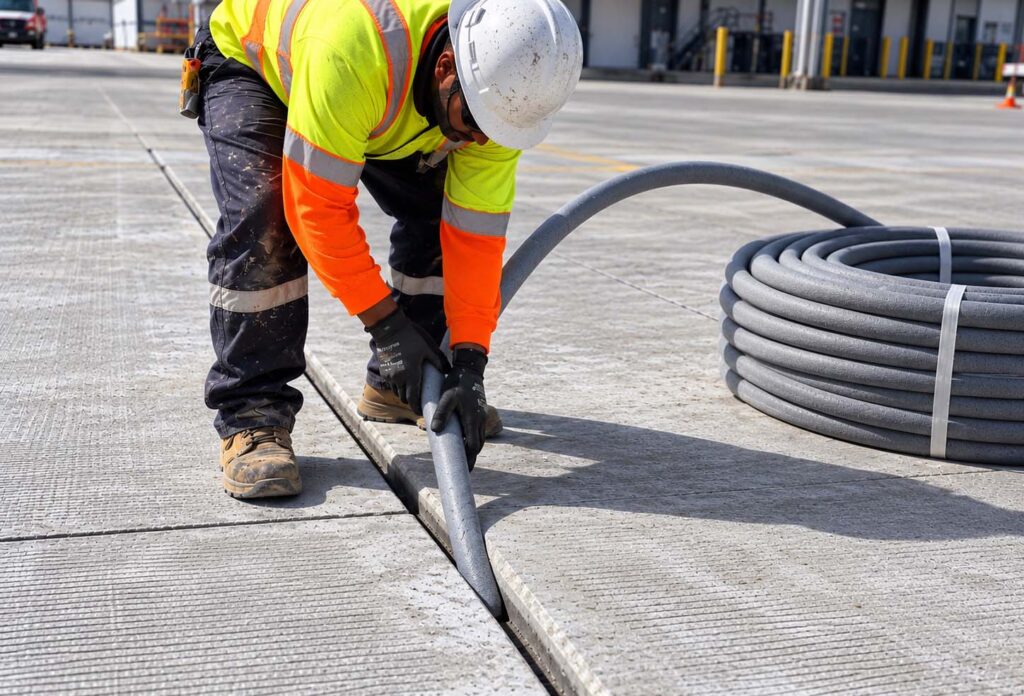
Weather and climate play a major role in the performance and durability of concrete pavements. Changes in temperature, moisture and environmental conditions cause concrete slabs to expand, contract and move over time. Without properly designed and maintained joints, these movements can contribute to cracking, joint deterioration and premature pavement damage.
Professional concrete pavement joint filling and sealing help protect joints against environmental exposure, water infiltration and debris accumulation while accommodating movement where required.
How Temperature Changes Affect Concrete Pavement Joints
Concrete naturally expands when temperatures rise and contracts when temperatures fall. In Australia’s climate, particularly across Brisbane and the Gold Coast, pavement surfaces can experience significant temperature variations throughout the day. These temperature changes affect joint width and movement, making material selection particularly important.
Flexible polyurethane sealants are commonly used in movement joints because they can accommodate expansion and contraction within their specified movement capability. Meanwhile, semi-rigid polyurea or epoxy fillers may be suitable for saw-cut control joints in industrial concrete floors where joint edge support is required. Choosing the wrong material can lead to cracking, debonding or premature joint failure.
Temperature Fluctuations and Slab Movement
Concrete slabs constantly move in response to daily and seasonal temperature shifts:
- Thermal Expansion (Hot Weather): High temperatures cause concrete slabs to expand, compressing the joints and narrowing the joint width. If a sealant is installed during extreme heat when joints are at their minimum width, subsequent cooling will stretch the sealant to its maximum capacity as the slabs pull apart, leading to adhesive or cohesive failure.
- Thermal Contraction (Cold Weather): Low temperatures cause concrete to contract, widening the joints. If filled during freezing conditions, summer heat will compress the sealant beyond its elastic limit, causing it to buckle, extrude, or tear.
- Optimal Application Window: Most manufacturers recommend sealing joints during moderate temperature ranges (10degC to 27degC or 50degF to 80degF `) when slabs are in a mid-range state of expansion.
Why Rainfall and Moisture Matter
Moisture is the primary enemy of joint sealants during the installation phase
- Bond Failure: Concrete must be completely dry and clean before applying polyurethane, silicone, or hot-poured bituminous sealants. Residual moisture inside the saw-cut reservoir turns into vapor or prevents the primer and sealant from bonding to the concrete sidewalls.
- Curing Interruption: High relative humidity or sudden rain showers can ruin freshly applied sealants, causing bubbling, blistering, or complete washout before the compound skin-cures.
UV Radiation and Weathering Degradation
Long-term climate exposure exposes joint sealants to harsh environmental stressors:
- Solar Radiation: Continuous ultraviolet (UV) exposure degrades lower-grade rubber and asphalt-based sealants, causing them to dry out, harden, crack, and lose elasticity.
- Chemical Exposure: In regions prone to heavy rainfall, industrial runoff, or de-icing salts, the climate accelerates chemical breakdown. High-performance elastomeric or silicone sealants are specifically selected to withstand persistent UV and moisture exposure without degrading.
Why Climate Conditions Influence Material Selection?
Not all concrete pavement joints serve the same purpose. Saw-cut control joints, construction joints and expansion joints experience different movement and loading conditions. Their filling or sealing systems must therefore be selected according to joint function, pavement use and environmental exposure.
For example, industrial pavements exposed to forklifts and heavy equipment may require joint edge protection, while external expansion joints generally need flexible sealing systems capable of accommodating anticipated movement.
UV exposure, rainfall, temperature fluctuations and chemical exposure should also be considered when selecting materials for outdoor pavements.
When Is the Best Weather for Concrete Pavement Joint Filling?
Generally, dry and stable weather conditions provide a more controlled environment for joint preparation and sealant installation. However, the ideal installation conditions depend on the specific product, substrate condition and manufacturer requirements. Professional joint sealing contractors assess these factors before starting work to minimise installation defects and improve long-term performance.
Professional Concrete Pavement Joint Filling and Sealing
At SealTech Industries, we provide professional concrete pavement joint filling and concrete pavement joint sealing solutions for commercial, industrial and civil applications. Our services include saw-cut control joint filling, construction joint sealing, expansion joint sealing and replacement of deteriorated joint fillers and sealants.
Contact us to discuss suitable joint filling and sealing solutions for your concrete pavement project across Brisbane, Logan, Ipswich, Tweed Heads and the Gold Coast.
xxx
Recent Posts
Related articles
- Commercial waterproofing
- Key Types of Concrete Joints in Commercial Construction
- Guide to Waterproofing – WIKI
- Comprehensive Moisture Control: SuperiorWaterproofing Introduces Rising Damp Solutions
- Expansion Joint Sealing Press Release
- Downloadable Capabilities
SealTech Industries
Expert joint sealing & waterproofing solutions for Southeast Queensland.
Contact Us