Why You Must Calculate Movement Capability Before Sealing Industrial Concrete
When designing or specifying sealant systems for industrial concrete floors, Movement Capability (MC) is one of the most important factors to get right.
Industrial slabs deal with constant stress from forklift traffic, pallet jacks, heavy wheel loads, temperature changes, and ongoing concrete shrinkage. If the sealant does not have the right movement capability, it can lose adhesion, split within the joint, or break down prematurely. Over time, this often leads to joint spalling, trip hazards, water ingress, and expensive floor repairs.
Below is a practical breakdown of movement capability requirements, standard classifications, and key material selection points for industrial concrete joint sealing.
1. Defining Movement Capability (MC)
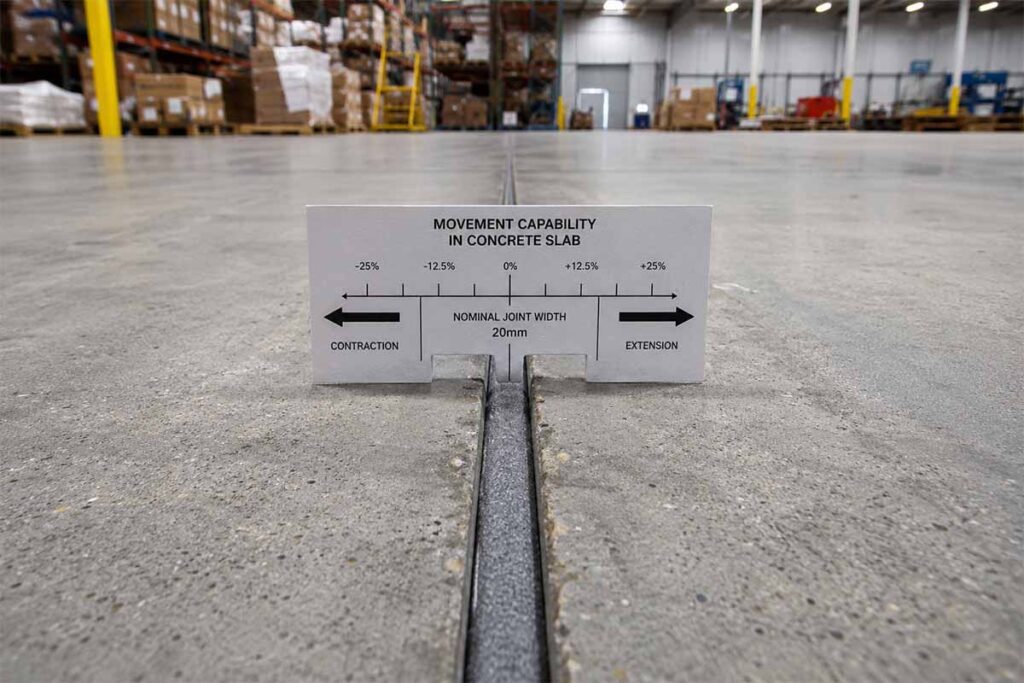
Movement capability is expressed as a percentage (+/- X %) of the nominal joint width at the time of installation. It defines how much a joint can expand (+), compress (-), or shear without the sealant failing.
Expansion (+): The joint opens up (e.g., when concrete cools and contracts).
Compression (-): The joint closes (e.g., when concrete heats up and expands).
For example, a 10mm joint with a +/-25% movement capability can safely open to 12.5mm or compress down to 7.5mm.
2. Types of Industrial Concrete Joints & Movement Expectations
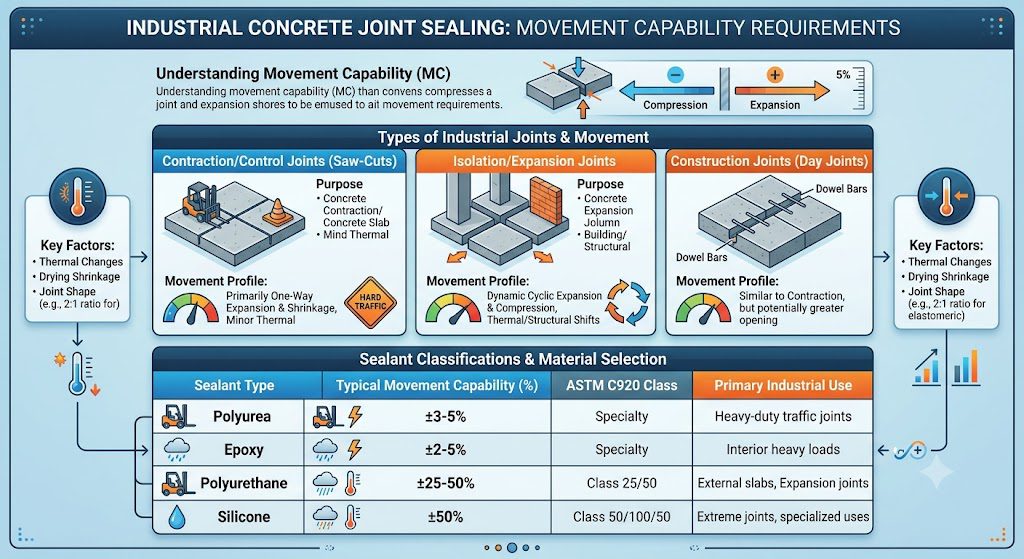
Not all concrete joints are the same. In industrial flooring, there are usually three main joint types, and each one needs the right sealant approach based on how much movement the joint is expected to handle:
Contraction / Control Joints (Saw-Cuts)
Purpose: These joints help control random cracking by creating a planned weak point in the slab as the concrete shrinks during curing.
Movement Profile: Movement is mostly one-way as the slab continues to shrink over time, with minor daily or seasonal movement caused by temperature changes.
Requirement: A low to moderate movement capability is usually suitable, but the sealant also needs a high Shore hardness to withstand forklift, pallet jack, and heavy wheel traffic crossing the joint.
Isolation / Expansion Joints
Purpose: These joints completely separate the slab from fixed structures such as columns, walls, machinery bases, and large slab sections, allowing each area to move independently.
Movement Profile: Movement is more dynamic, with ongoing expansion and compression caused by structural movement, temperature changes, and slab movement over time.
Requirement: A high movement capability is required, typically ±25% to ±50%, to handle continuous joint movement without adhesive or cohesive failure.
Construction Joints (Day Joints)
3. Sealant Classifications & Material Selection
Industrial sealants are classified by ASTM C920 (Standard Specification for Elastomeric Joint Sealants) or ISO 11600 based on their movement performance and application type.
Sealant Type
Movement Capability
Standard Class (ASTM C920)
Primary Industrial Use Case
Polyurea (Rigid/Semi-Rigid)
± 3% to ±5%
N/A (Specialty)
Heavy-duty traffic control joints. Provides maximum edge protection against forklift wheels. Minimal movement flexibility.
Epoxy (Semi-Rigid)
±2% to ±5%
N/A (Specialty)
Interior joints with heavy loads. High compressive strength to prevent joint spalling; very low movement tolerance.
Extreme expansion joints or specialized chemical/washdown environments. Not suitable for direct heavy wheel traffic.
4. Key Factors Influencing Industrial MC Calculations
When calculating the required movement capability for an industrial concrete floor, engineers need to consider several factors that influence how much a joint will open and close over its service life.
Thermal Expansion and Contraction
Temperature changes cause concrete to expand and contract throughout the year. The difference between the highest and lowest operating temperatures (ΔT) determines the amount of thermal movement a joint will experience. This is particularly important in environments such as cold storage facilities, freezers, and temperature-controlled warehouses, where temperature variations can be significant.
Where alpha is the coefficient of thermal expansion for concrete, and L is the slab length.
Concrete Drying Shrinkage
Concrete continues to release excess moisture and shrink for months, and in some cases years, after placement. If joints are sealed too early in the construction cycle, the sealant can be placed under significant, permanent tensile strain as the concrete continues to pull away.
For industrial floors, this can increase the risk of adhesive failure, cohesive tearing, joint edge damage, and premature sealant breakdown under heavy traffic.
Joint Width-to-Depth Ratio (Shape Factor)
For movement joints sealed with elastomeric sealants such as polyurethane or silicone, the standard guide is a 2:1 width-to-depth ratio.
A shallower sealant depth helps reduce internal stress when the joint expands, allowing the sealant to stretch and recover more effectively.
Note: This rule does not apply to semi-rigid polyurea or epoxy fillers used in control joints. These are typically installed to the full depth of the saw-cut, or to a minimum depth of 25mm, to provide proper support for heavy wheel loads.
5. Summary of Best Practices
For traffic support: If heavy forklift or pallet jack traffic is damaging the joint edges, prioritise hardness over movement capability. Use a polyurea or semi-rigid epoxy filler, typically Class 15 or lower, and install it flush with the floor surface to help protect the joint shoulders.
For thermal or structural movement: If the joint is outdoors or separates different structural elements, elasticity is more important. A Class 25 or Class 50 polyurethane sealant is generally the better option for handling expansion, compression, and ongoing slab movement.
Delay sealing where possible: Allow the concrete slab to cure for as long as the project schedule allows, ideally 28 to 90 days, before sealing. This helps reduce the impact of early drying shrinkage and improves long-term sealant performance.