
Best Practices for Asphalt Pavement Crack Sealing in Commercial Facilities
To keep commercial pavements in top condition, asphalt pavement crack sealing must be done at the right time, with the right materials, and with proper preparation. Following these best practices ensures a long-lasting, durable seal that protects your asphalt investment.
When to Seal
Timing plays a major role in how well crack sealing performs.
- Ideal Season
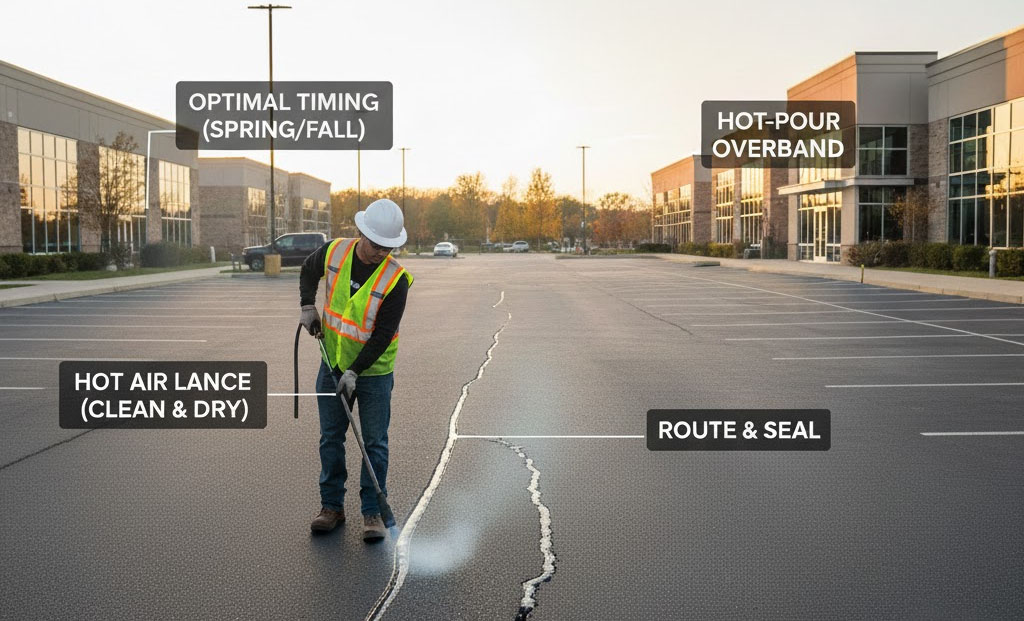
Carry out asphalt crack repair and sealing in spring or autumn, when cracks are at a moderate width — not overly expanded from summer heat and not tightly closed from winter cold. This helps the sealant flex with temperature changes throughout the year. - Temperature Requirements
Most manufacturers recommend sealing only when pavement temperatures are at least 40°F (4°C) and rising. Colder temperatures reduce adhesion and flexibility. - Weather Conditions
Avoid sealing when rain or moisture is present or expected. The pavement must be completely dry, as moisture significantly reduces bond strength.
Crack Preparation
Thorough preparation is the most important step for achieving a long-lasting seal.
Inspection & Classification
Start with a detailed assessment to identify the type and movement of each crack:
- Asphalt pavement crack sealing is best for working cracks — those that expand and contract noticeably (often transverse cracks).
- Crack Filling works better for non-working cracks with minimal movement (typically longitudinal cracks).
- Cracks wider than 1 inch, or areas showing alligator cracking, usually require patching rather than sealing.
Cleaning
Effective bonding requires a clean, dry crack. Use:
- High-pressure compressed air (minimum 90 PSI)
- A hot-air lance to clean, dry, and warm the crack for better adhesion (without overheating or burning the pavement)
Crack Routing (Optional but Recommended)
For working cracks, routing creates a uniform reservoir and improves sealant performance. A typical routed reservoir is:
- About 1/8 inch wider on each side of the original crack
- Deep enough to hold sufficient sealant for long-term movement
Concrete crack routing must be centered over the crack to ensure even bonding.
Material Selection & Proper Application
Choosing the right sealant and applying it correctly ensures maximum durability.
Material Selection
For asphalt driveway or concrete driveway joint sealing, use flexible, polymer‑modified, hot‑pour sealants that meet ASTM or AASHTO standards. Hot‑pour materials generally outperform cold‑applied fillers in commercial settings
Heating
Heat the concrete sealant only within the manufacturer’s recommended temperature range — typically 380°F to 410°F (193°C to 210°C).
- Overheating breaks down the sealant
- Underheating reduces flow and adhesion
Keep the melter agitated to maintain uniform consistency.
Application
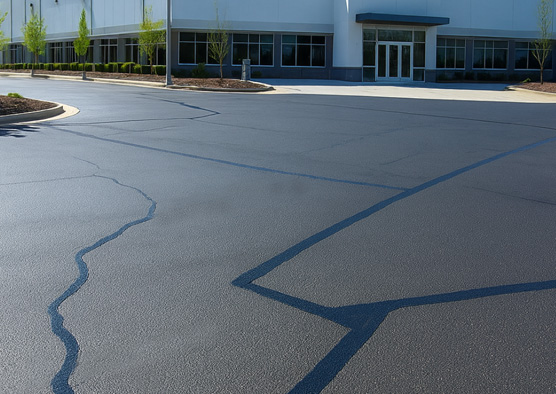
- Fill the crack from the bottom up
- Use the correct wand tip for either a flush finish or an overband application
- The overband method is commonly preferred for active cracks
- Do not overfill — sealant should sit no more than ⅛ inch above the pavement surface
Curing
Allow proper curing time before reopening to traffic. In most cases, this takes only a few hours.
Long-Term Maintenance
Concrete car park or driveway crack sealing is preventive maintenance, not a structural repair — ongoing care is essential.
Routine Inspections
Conduct scheduled inspections to identify new or returning cracks early.
Sealcoating
Apply a protective sealcoat every 2–3 years. This protects both the asphalt and the crack sealant from UV rays, water, and chemical spills. Always seal cracks before sealcoating.
Expected Lifespan
With correct application and regular maintenance, asphalt pavement crack sealing typically lasts 3 to 8 years, depending on climate and traffic load.
Final Thoughts
By sealing driveway and parking cracks at the right time, preparing the pavement properly, using high-quality materials, and following correct application techniques, commercial facilities can significantly extend the life of their asphalt surfaces. These best practices help reduce long-term maintenance costs, improve safety, and keep your property looking professional year-round.